
White Papers
Executive Summary
Post-trade operations are at an inflection point. The convergence of compressing settlement timelines, exponentially growing trade volumes, and relentless cost pressure has rendered the traditional model of human-intensive, manual exception management unsustainable. At the same time, a generational shift in artificial intelligence capability — particularly the emergence of Agentic AI — has created a credible, deployable path to a new operating model. This whitepaper examines why the moment for transformation has arrived, what a responsible and regulatorily sound automation architecture looks like, and how eClerx is uniquely positioned to help financial institutions navigate this transition.
1. Why Automation Is No Longer Optional
Settlement Timelines Are Compressing
With the US, Canada, and Mexico adopting T+1 settlement and Europe planning a similar shift by 2027, post-trade operations face significant pressure. Operations teams now have half as much time to resolve issues, with increased penalties for settlement failures. Manual processes can't keep up; automation is essential as settlements move toward real-time.
Trade Volumes Are Growing Faster Than Headcount Can Scale
Trading volumes are increasing globally, far outpacing the capacity of manual operations. US equity trading has nearly doubled in a decade, and derivatives and ETF markets have also expanded rapidly. Traditional models that scale linearly with volume aren’t sustainable, making automation necessary to manage growth without unsustainable cost increases.
Cost Reduction Imperatives Are Intensifying
Investment banks are under pressure to cut costs, particularly in post-trade processing, which globally costs $50–$100 billion annually. Manual exception handling drives these expenses, and high fail rates add further financial strain. Outsourcing options are mostly spent; meaningful cost reduction now depends on automating processes rather than relying on human execution.
2. Why Now Is the Right Time to Automate
System and Data Infrastructure Have Matured
Banks have invested in strengthening their platforms. Core processing platforms now offer APIs for data access and instruction submission. Industry utilities have upgraded connectivity, while reference data standards like LEI, UPI, and CFI have reduced ambiguity. Cloud infrastructure enables scalable AI deployment, and structured, reliable data pipelines now provide all needed inputs. The groundwork for agentic AI is firmly established.
Generative AI Has Unlocked Cognitive Automation
Earlier automation methods handled basic tasks but couldn't manage ambiguity or require judgement. Generative and Agentic AI, built on large language models, now interpret unstructured data, reason across sources, draft communications, and automate complex workflows. Manual processes are increasingly automatable—the moment for adoption has arrived.
3. The Right Automation Architecture: Augmenting, Not Replacing, Core Systems
Core Processing Platforms Contain Essential Knowledge
Replacing established post-trade platforms with AI risks losing decades of critical financial, operational, and regulatory logic. These systems house complex knowledge gained from market events and regulatory shifts, making them too vital to discard or leave to manual oversight. Transitioning away from them is risky, lengthy, and threatens institutional memory.
Deterministic, Explainable Processing Is Required
Regulators across regions demand that automated decisions remain deterministic, auditable, and explainable. Core platforms deliver these standards through rule-based engines and audit trails, so architectures for Agentic AI must continue to support this transparency.
Agents Replace Human Workflow Layers
Agentic AI should augment, not replace, core platforms by taking over tasks currently managed by operations staff—such as interpreting data and executing actions between systems and participants. Agents serve as orchestrators and communicators, ensuring continuous, scalable, and auditable workflow while preserving the core systems as records of truth.
4. The Agent Ecosystem: A Network of Specialised, Coordinated Agents
A viable and practical agentic architecture for post-trade operations is built on a network of agents with defined, generic capabilities that operate across each functional domain of the trade processing lifecycle. Rather than building bespoke automation for each process in isolation, this approach creates reusable agent types that are configured and deployed across Statics and Account Management, Trade Allocation, Trade Control, Trade Confirmation, Settlements, and Corporate Actions
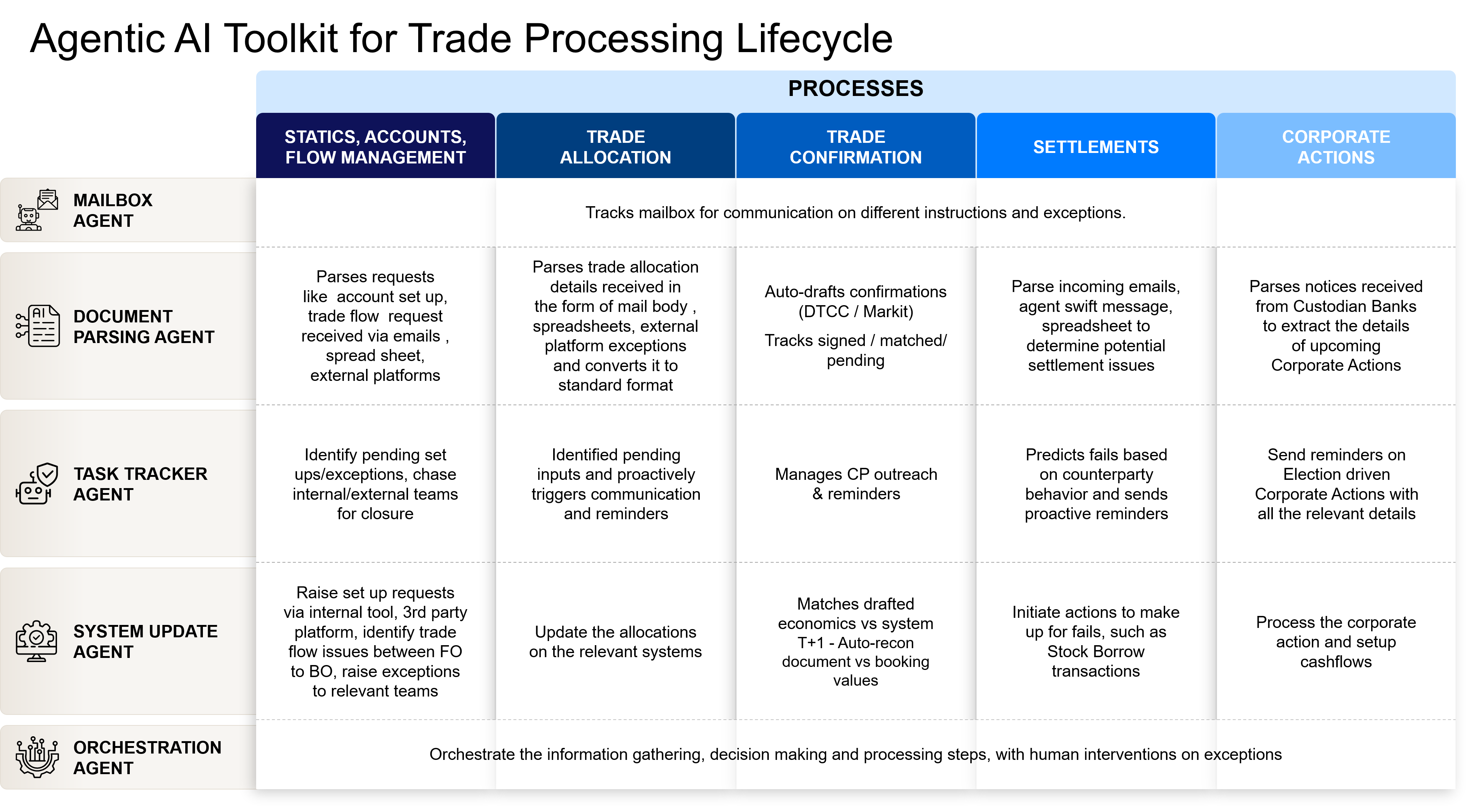
The Mailbox Agent serves as the universal intake layer, continuously monitoring communication channels across all process domains. It identifies incoming instructions, exceptions, counterparty responses, and custodian notices, and routes them to the appropriate specialist agents for processing
The Document Parsing Agent provides the cognitive translation layer. It ingests communications in any format — email body text, spreadsheet attachments, SWIFT messages, third-party platform exports, PDF notices — and converts them into structured, standardized data that downstream agents and processing systems can act upon. In the context of Trade Allocation, this means converting allocation details from whatever format a client or fund manager sends them into the standard format required for system update. In Corporate Actions, it means extracting event details from custodian bank notices with precision and without manual rekeying.
The Task Tracker Agent The Task Tracker Agent manages proactive outreach across the lifecycle. Rather than waiting for a deadline to be missed, this agent identifies pending items — unsigned confirmations, unmatched allocations, open trade control breaks, pending settlement fails — and proactively initiates communication with internal teams and external counterparties. In the Settlements domain, it goes further, using counterparty behavioral patterns to predict fails before they occur and issuing pre-emptive reminders to mitigate them.
The System Update Agent executes decisions within defined authority parameters. It raises setup requests in internal tools and third-party platforms, updates allocations on relevant systems, resolves trade control breaks based on standard operating procedures, performs T+1 reconciliation of confirmation documents against booking values, initiates stock borrow transactions to cover settlement fails, and processes corporate action elections and cashflow setups. This is the agent that directly reduces the human processing workload.
The Orchestration Agent provides the coordination layer across the entire
ecosystem. It
manages the sequencing of information gathering, reasoning, and action across the specialist
agents, determines when human intervention is required and routes exceptions to the
appropriate human authority, and maintains the audit trail of decisions and actions across
the workflow.
he agents must operate under human supervision, with checks and balances in
the form of
approvals and sign-offs, with a control switch to hold back action when required. The
convenience of having all inputs to make informed decisions is a powerful enabler for
efficient processing.
5. The Regulatory Dimension: Responsible AI by Design
Accountability Cannot Be Delegated to a Machine
Regulators across the EU, UK, and US have been unambiguous: the deployment of AI in regulated financial workflows does not transfer accountability from the institution to the technology. Under frameworks such as the UK's Senior Managers and Certification Regime, a named individual remains personally accountable for the decisions made by automated systems operating within their area of responsibility. Any agentic architecture deployed in post-trade operations must therefore be designed with explicit accountability mapping — every agent function must have a designated human owner, a documented governance framework, and a tested override mechanism. This is not a constraint to be worked around; it is a design principle to be embedded from the outset.
Systemic Risk Must Be Actively Managed
Regulators retain vivid institutional memory of the 2010 Flash Crash, in which automated trading systems amplified a market stress event into a trillion-dollar intraday loss. The prospect of agentic AI operating simultaneously across settlement, collateral, and regulatory reporting at multiple systemically important institutions raises legitimate concerns about correlated, automated failures at speed and scale. Responsible agentic architecture must incorporate circuit-breaker mechanisms that pause automated processing when anomalous conditions are detected, volume thresholds that trigger human review, and diversity in decision logic that prevents homogenous responses to market stress. The goal is not to slow automation down but to ensure that speed is matched by appropriate safeguards.
6. How eClerx Can Help
eClerx combines domain expertise with technology, making it a strong partner for financial institutions undergoing transformation. With extensive experience in post-trade operations—including settlements, reconciliations, corporate actions, and collateral management—eClerx offers insights beyond what technology vendors provide, understanding both process mechanics and underlying motivations such as regulatory requirements and institutional customs.
This operational knowledge underpins reliable and robust agentic AI solutions, informed by real-world patterns and escalation decisions from years of practical experience. eClerx prioritizes responsible AI design, integrating explainability, human oversight, and audit trail integrity to meet regulatory standards. We support institutions not only in deploying agentic technology but also in establishing governance and model risk management frameworks. eClerx Roboworx Cogniflows provides a robust framework to build agentic automation solutions at scale. Our process excellence wrapper, ProcessEX, provides the human-agent interface and interaction layer to run these agents in a controlled, compliant environment. For more information on eClerx's Agentic AI capabilities in Financial Markets post-trade operations, please contact your eClerx relationship manager or visit www.eclerx.com
Author
Gokulraj Perumal,
Associate Principal, Technology Services
